
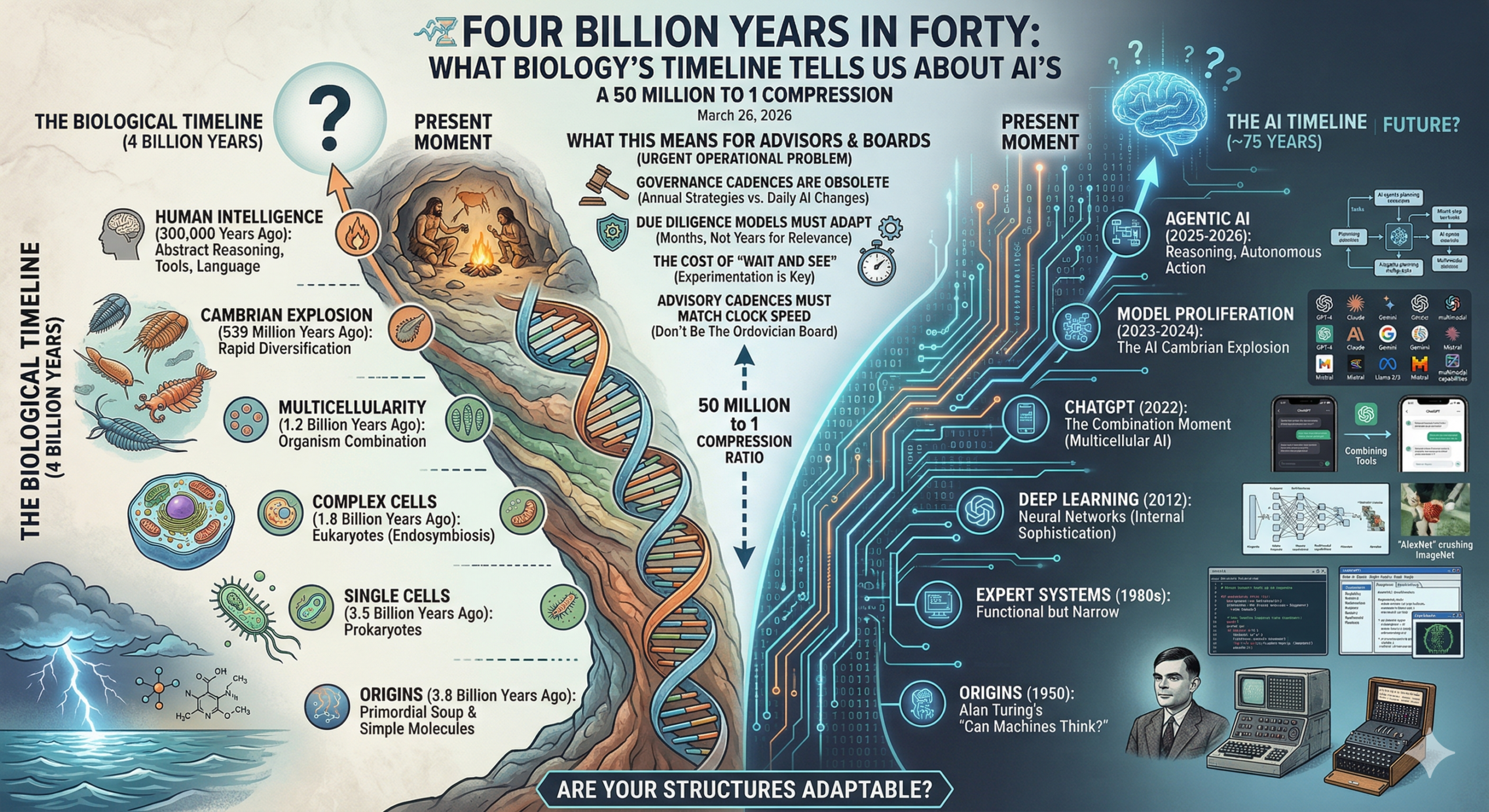
Here is a number worth sitting with: approximately fifty million to one.
That is the rough compression ratio between the timeline of biological evolution and the timeline of artificial intelligence. Biology took nearly four billion years to progress from the first self-replicating molecules to a species capable of general reasoning. AI has retraced a strikingly similar arc in roughly seventy-five years — from Alan Turing’s 1950 paper asking “Can machines think?” to systems that can reason, write code, and use tools autonomously.
This is not a loose metaphor. The parallels are structural. And the implications for anyone advising companies, sitting on boards, or running due diligence on technology-dependent businesses are more urgent than most realize.
🔬 The Parallel Timeline
Consider how the major chapters of biological evolution map onto the development of AI.
🌋 The Primordial Soup and the Turing Test (Origins)
Around 3.8 billion years ago, simple organic molecules formed in Earth’s early oceans — perhaps catalyzed by lightning, perhaps delivered by comets. No life yet. Just raw chemical potential in the right conditions.
In 1950, Turing published “Computing Machinery and Intelligence.” In 1956, a group of researchers at Dartmouth coined the term “artificial intelligence.” No working intelligence yet. Just theoretical potential in the right conditions.
Biology’s primordial era lasted hundreds of millions of years. AI’s lasted roughly a decade.
🧫 Single Cells and Expert Systems (Functional but Narrow)
The earliest prokaryotic organisms appeared around 3.5 billion years ago — remarkable molecular machines, capable of metabolism and reproduction, but each one limited to a single function in a single environment.
The expert systems of the 1980s and early 1990s were AI’s single-cell organisms. MYCIN could diagnose blood infections. XCON could configure computer orders. Each was impressive within its narrow domain and useless outside it. Like prokaryotes, they were functional but rigid — incapable of generalizing.
Biology spent roughly two billion years in the single-cell era. AI spent about thirty years.
🧬 Complex Cells and Deep Learning (Internal Sophistication)
Around 1.8 billion years ago, something remarkable happened: endosymbiosis. Smaller prokaryotes were engulfed by larger cells and, instead of being digested, became permanent internal components — mitochondria, chloroplasts. The result was the eukaryotic cell: a single organism with specialized internal machinery working in coordination. A leap in complexity within a single unit.
In 2012, a deep learning model called AlexNet crushed the ImageNet visual recognition challenge, and the deep learning revolution began. Neural networks with multiple specialized layers — each performing a different function, all working in coordination within a single model. Like the eukaryotic cell, the breakthrough was internal sophistication: components that complemented each other within a unified architecture.
Biology’s journey from prokaryote to eukaryote took roughly 1.7 billion years. AI’s equivalent took about thirty years.
🧩 Multicellular Life and ChatGPT (The Combination Moment)
This is the centerpiece parallel, and it deserves attention.
Around 1.2 billion years ago, individual cells began organizing into multicellular organisms. This was not just “more cells.” It was a fundamentally different kind of entity. Specialized cells — for sensing, moving, digesting, defending — combined into something that could interact with its environment in a general way. Before multicellularity, every organism was a specialist. After it, organisms could be generalists.
On November 30, 2022, OpenAI launched ChatGPT. It reached 100 million users in two months — the fastest-growing consumer application in history.
But the significance was not the growth rate. It was what ChatGPT represented architecturally. Before ChatGPT, AI systems were specialists: one model for translation, another for image recognition, another for text generation. ChatGPT combined capabilities — language understanding, reasoning, knowledge retrieval, code generation — into a single system that could interact with humans generally. It was AI’s multicellular moment.
Biology took roughly 2.3 billion years to go from single-cell to multicellular. AI took about ten years.
💥 The Cambrian Explosion and the Model Proliferation of 2023–2024
Approximately 539 million years ago, something extraordinary happened in the fossil record. Over a period of just 13 to 25 million years, nearly every major animal phylum that exists today appeared. Arthropods, mollusks, chordates, echinoderms — the basic body plans that still define animal life emerged in a geological blink. Scientists still debate why. But the pattern is unmistakable: a sudden, explosive diversification after billions of years of relatively gradual change.
Now look at 2023 and 2024. In roughly eighteen months: GPT-4 (March 2023). Claude (March 2023). Gemini (December 2023). Llama 2 and 3 (July 2023, April 2024). Mistral, Qwen, Grok, Command R. Multimodal models that could process text, images, audio, and video. Open-source models that democratized access. Specialized models for code, science, medicine, and law.
Biology’s Cambrian explosion produced the body plans that still define animal life 500 million years later. AI’s Cambrian explosion — still underway — is producing the model architectures and capabilities that will define machine intelligence for decades to come. Biology’s version took at minimum 13 million years. AI’s has taken 18 months.
🧠 Human Intelligence and the Present Moment
Homo sapiens appeared roughly 300,000 years ago — the first species capable of abstract reasoning, tool creation, language, and long-term planning. The culmination of four billion years of evolutionary iteration.
In 2025 and 2026, AI systems are demonstrating reasoning, autonomous tool use, multi-step planning, and the ability to operate as agents — pursuing goals across extended timeframes with minimal human supervision.
We are watching, in real time, the compression of an evolutionary timeline that took biology four billion years into a span of roughly seventy-five.
🏛️ So What Does This Mean for You?
If you are sitting on a board, advising a portfolio company, or responsible for technology due diligence, the compression ratio is not an interesting analogy. It is an operational problem.
Consider what it implies:
Your governance frameworks were designed for evolutionary speed. Annual strategy reviews. Quarterly board meetings. Three-year technology roadmaps. These cadences assume that the landscape changes gradually enough that periodic check-ins suffice. When one year of AI development compresses fifty million years of biological evolution, “we will revisit our AI strategy at the next offsite” is not caution. It is negligence.
Your due diligence models are looking at the wrong timescale. Traditional technology due diligence evaluates a company’s current stack and asks whether it is adequate for the foreseeable future. But “foreseeable” now means months, not years. A SaaS platform that looks robust in January may be architecturally obsolete by June — not because it failed, but because the capabilities available to its competitors changed that quickly.
The “wait and see” approach has a cost most people are not calculating. In evolutionary biology, the organisms that survived the Cambrian explosion were not the ones that waited to see which body plans would win. They were the ones already experimenting. Companies and advisors who are “monitoring AI developments” without actively experimenting are accumulating a capability gap that compounds with every quarter of inaction.
Advisory cadences need to match the clock speed of the technology. If you are advising a company on its AI strategy and meeting quarterly, you are operating at roughly one-fourth the speed required. The Cambrian explosion did not pause for the Ordovician board meeting. AI will not pause for yours.
❓ The Question Worth Asking
The deepest lesson from the biological parallel may be this: evolution does not announce its phase transitions. The Cambrian explosion was not preceded by a memo. Multicellularity did not come with a press release. The organisms that thrived were the ones whose structures were already adaptable when the pace changed.
The question for advisors and board members is not “how fast is AI moving?” Everyone knows the answer to that. The question is: are your decision-making structures, your governance frameworks, and your advisory relationships built for the speed at which the landscape is actually changing?
Because if they are built for evolutionary speed, and we are living through revolutionary speed, the compression ratio will find you. It always does.
This article appeared first on thekernel.io.
